
Kershaw Projected and Actual Release
A projected release date is SCDC's current calculation for when a sentenced state prisoner may leave prison under the information in the record. It can reflect the sentence, jail credit, concurrent or consecutive terms, and credits actually earned or lost. The same report may show PROJECTED PAROLE ELIGIBILITY and SUP. REENTRY ELIGIBILITY. Those are separate milestones. Parole eligibility marks a chance for Board review, while supervised reentry refers to a defined transition status. Neither is an actual gate time.
An actual release date records an event that has already occurred. Even on the projected day, processing can be affected by a court correction, disciplinary action, another agency's hold, or a transfer. A Kershaw County detainee awaiting court is different. There may be a bond hearing or release order, but no fixed sentence-based date exists until lawful authority permits departure and KCDC completes the process.
Scheduled versus actual: Treat every projected date as a pending calculation. Confirm physical departure with KCDC or SCDC and obtain the completed release record.
| Record term | What it means | What it does not prove |
|---|---|---|
| Projected release date | SCDC's current calculated sentence-release point | That release has occurred |
| Projected parole eligibility | Potential point for Board consideration | That parole will be granted |
| Supervised reentry eligibility | Potential eligibility for a defined transition status | Unconditional sentence discharge |
| Actual release date | Recorded departure after processing | That all supervision has ended |
Find a Kershaw Release Date
Begin with the custody level, not the person's home county. The SCDC Incarcerated Inmate Search covers people currently sentenced to and incarcerated in the South Carolina prison system. It does not cover KCDC-only sentences, released SCDC offenders, community supervision, juveniles, or current fugitives. SCDC says its public data reflects custody as of midnight the prior day, so a recent change may not yet appear.
- Determine whether the person is in KCDC, an SCDC institution, federal custody, or another jail. A Kershaw case alone does not establish the current custodian.
- For current SCDC custody, search by SCDC or SID number when known, or use the available name criteria. Open the matching official detail report.
- Read
PROJECTED RELEASE DATE,PROJECTED PAROLE ELIGIBILITY, andSUP. REENTRY ELIGIBILITYas distinct fields. Check the offenses, sentence dates, movements, and credit sections for context. - For a local KCDC sentence, call the detention center and review the judgment through the Kershaw Public Index. Request the official sentence calculation rather than applying SCDC's date.
- After departure, use the SCDC Released Inmate Search for a state release or request KCDC's booking and release record for a county departure.
The official SCDC incarcerated search is the source for a current state prisoner's detailed date fields. The captured search screen shows the proper starting point for a live SCDC record.
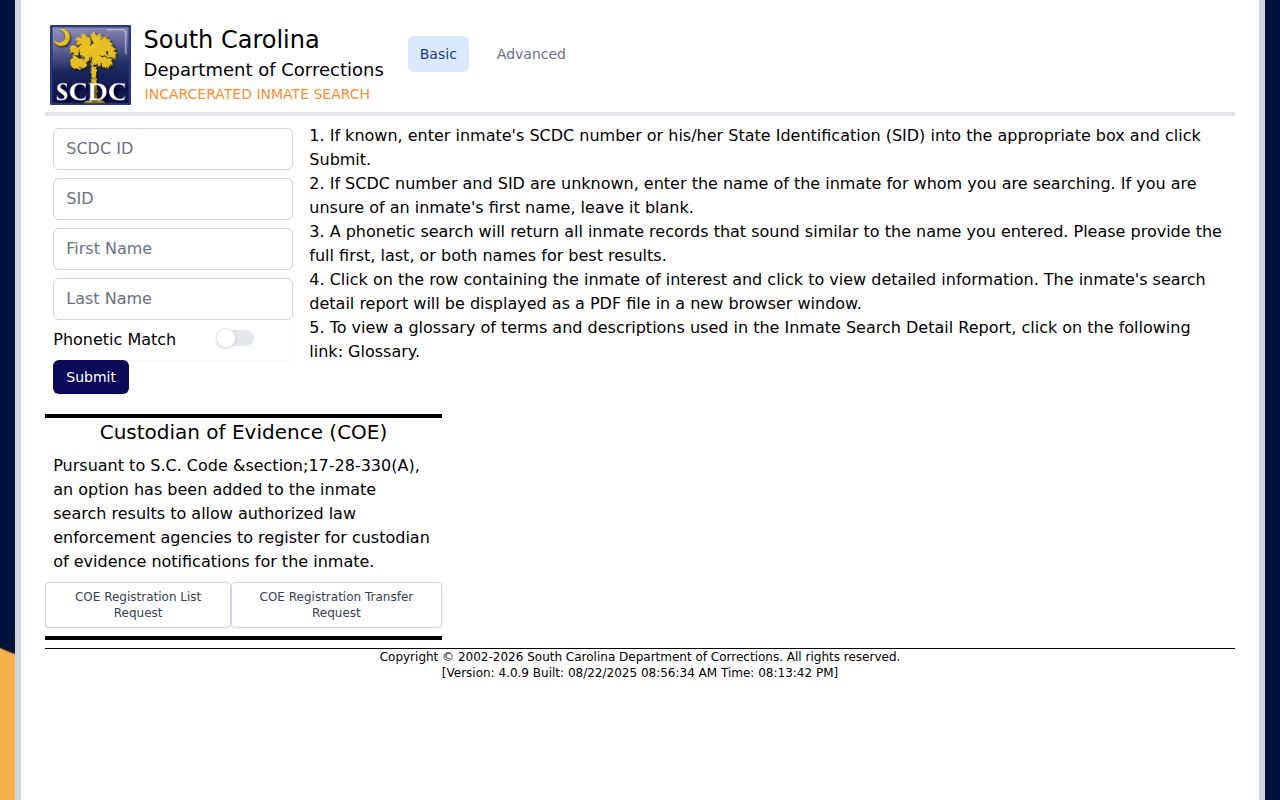
A result from this search applies to SCDC custody. It must not be presented as Kershaw County Detention Center's local sentence calculation.
The detail report offers more context than a date alone. Depending on the selected record, it can include admission and current location, sentence start, current offenses, movement history, disciplinary sanctions, earned-work and earned-education entries, and the projected parole or reentry fields. Read only what the live record displays. A picture date identifies the image, not a custody event. Movement history may also explain why a Kershaw County case is being served at an institution elsewhere in South Carolina. SCDC custody follows the sentenced person statewide rather than the county name.
Note: A missing SCDC result may reflect release, county custody, a recent update, or another exclusion; it is not release proof.
Kershaw Release Credits and Sentences
South Carolina law supplies several inputs to an SCDC projected release date. Under Title 24, Chapter 13, Section 24-13-210 provides good-conduct credit. An eligible SCDC inmate serving an offense outside the statutory no-parole category earns a deduction computed at 20 days for each month served. For a no-parole offense, the rate is three days per month. Misconduct can lead to forfeiture. Offense date, sentence type, eligibility, and later amendments must be checked before using either rate.
Section 24-13-230 addresses earned-work credit, while Section 24-13-235 covers earned-education credit. For a qualifying person outside the no-parole category, productive work or an active academic, technical, or vocational program can earn from zero to one day for each two days of participation, with a combined annual cap of 180 days. A qualifying no-parole offender may receive six days per month, capped at 72 days per year, subject to the statutory floor and exclusions. The report's credit entries show inputs. They are not authority for an unofficial calculation.
A no-parole offense is defined in Section 24-13-100 with offense-class and punishment details. Section 24-13-150 generally requires at least 85 percent of the actual unsuspended prison term for such an offense before early release, discharge, or applicable community supervision. That floor is calculated without the listed work, education, or good-conduct credits. Life, death, mandatory-minimum, and offense-specific rules require close reading. Ask SCDC for the operative calculation rather than subtracting the largest possible credit from the sentence.
- Good-conduct credit
- A statutory deduction tied to rule compliance and sentence category.
- Earned-work credit
- Credit based on eligible productive duty or approved program participation.
- Earned-education credit
- Credit linked to qualifying education activity under state law.
- Truth in sentencing
- The statutory minimum service rule for defined no-parole offenses.
Why Kershaw Release Dates Change
The calculation can move in either direction as the official record changes. A corrected judgment may alter the term or how sentences run. Jail credit may be added or fixed. Earned credit can accrue, while disciplinary findings can remove credit. A new detainer may stop community release even when one sentence reaches its date. Parole decisions and the timing of a community-supervision phase can also change the route without changing every field in the same way.
| Factor | Possible effect | Confirm with |
|---|---|---|
| Judgment correction | Changes term, credit, or concurrent/consecutive structure | Sentencing court and SCDC |
| Jail credit | Adds verified pre-sentence confinement credit | Court, jail record, and SCDC |
| Work or education | Adds only credits actually earned and allowed | SCDC detail and sentence computation |
| Disciplinary loss | Forfeits or delays applicable credit | SCDC disciplinary and credit record |
| Detainer or hold | Can cause transfer rather than community release | SCDC and requesting agency |
| Parole action | Changes the potential path to supervised release | Board result, SCDC, and SCDPPPS |
A date change is not automatically an error. Record the date on which the detail report was checked and compare later versions. If the reason is unclear, request the public sentence-calculation fields or contact the responsible records office. The projected date is strongest when read with its timestamp, offense information, and credit history.
Kershaw Calculator Is Not Official
South Carolina provides an unusually visible educational release-date calculator, but its warning is decisive. It offers general guidance and is not an official SCDC record. It also says it cannot calculate the release date of an inmate who has already been sentenced. Fields such as the offense, earned-credit release date, and truth-in-sentencing indicator help explain the framework. They should never override a current detail report or agency computation.
The official calculator warning is shown in the manifest screenshot below. It is the source that limits how this tool should be used for a Kershaw County projected release question.
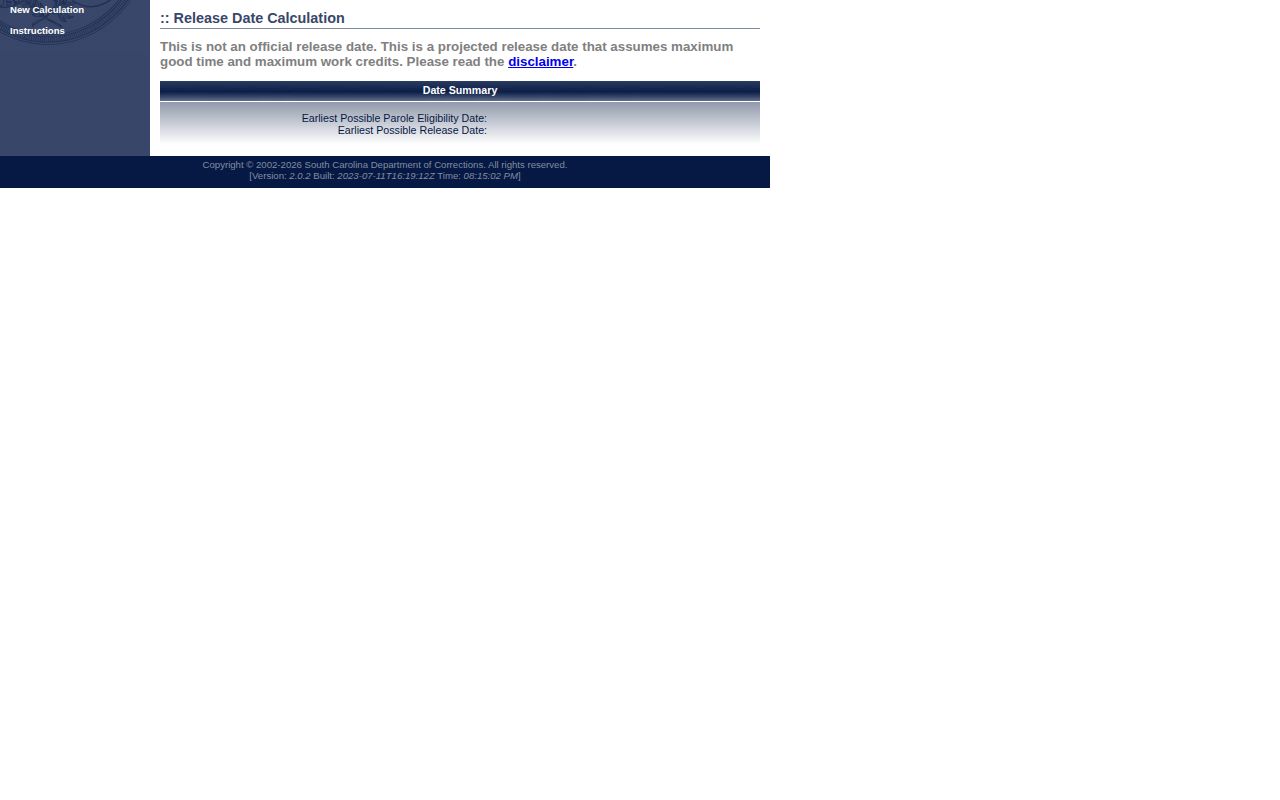
The warning directs a sentenced-person inquiry back to the official record. An estimate made with the calculator cannot be treated as an appointment, promise, or completed release.
Calculator limit: Use the public calculator to understand variables only. Use the SCDC report and staff for an actual sentenced inmate.
Kershaw County Jail Release Computation
Do not apply an SCDC projection to a person serving only a Kershaw County Detention Center sentence. KCDC's reviewed pages publish no local sentence calculator or county-specific good-time policy. Sections 24-13-210 and related provisions can contain language relevant to some locally confined state prisoners or designated arrangements, but the local official and sentencing authority must determine the actual date from the judgment, jail credit, classification, and governing law.
Contact the Kershaw County Detention Center at 803-425-1516 and ask which office can provide the existing sentence computation or release record. Review the court case for the judgment and later orders. A pretrial detainee may bond out, be released by court order, have a charge dismissed, or move to another custodian. None of those paths can be predicted by taking days off an unadjudicated charge.
The difference is practical. SCDC calculates a state prisoner's projected date in its own information system. KCDC and the court account for a county sentence. A transfer from KCDC to SCDC or another authority is a custody movement, not release into the community. Ask for the destination and the legal authority whenever the jail says a booking has closed.
The Kershaw Public Index can supply the filed judgment, bond activity, and later court orders when those materials are public. KCDC supplies the administrative fact of continued detention or departure. Use both because an order may explain the legal authority before the jail finishes processing it. For a narrow inquiry through the Kershaw County records-request route, provide the full name, booking or case number, sentencing date, and the specific sentence-computation or release fields sought. That helps the custodian identify an existing record without being asked to create a new estimate.
Note: A bond hearing time is not a physical-release time; paperwork, identification, and unresolved holds may still affect departure.
Confirm Kershaw Actual Release Dates
For a current state prisoner, begin with the dated SCDC detail report. If a release appears near, contact SCDC or its records staff for the current computation. After departure, use the SCDC Released Inmate Search. That separate tool accepts a date range and county, displays results ten at a time, and offers an Export option with more detail. It covers SCDC releases, not every person who leaves KCDC.
For a county detainee or local sentence, call KCDC and request the booking and release record with actual date, time, release type, authority, and destination. Pair that record with the court case. The broader Kershaw County release-record path explains how the current jail list, Public Index, state systems, and records request fit together.
VINELink can add a near-real-time signal when the person and agency participate. Register before the expected event and confirm every alert with the originating agency. The Kershaw VINELink inmate search explains the county registration path and the separate SCDC victim-notification route. A notification is useful, but the jail or corrections release record remains the final proof of what happened.