
Kershaw Parole and Probation Differences
The South Carolina Department of Probation, Parole and Pardon Services, or SCDPPPS, supervises several kinds of community status in Kershaw County. Parole is a conditional release from prison authorized through the South Carolina Board of Paroles and Pardons. The person serves the rest of the applicable term in the community under stated rules. Probation is imposed by a court. It can replace incarceration, follow a short term, or form one part of a sentence. A probation record therefore does not prove that someone was released from SCDC or the Kershaw County Detention Center.
Other labels matter. South Carolina community supervision can follow the prison portion of a qualifying no-parole sentence. Supervised reentry is another defined transition from confinement to monitored community status. Each has its own legal basis. Copy the status from the official record instead of calling every supervised person a parolee. For the underlying Kershaw County release event, use the booking record, court case, or SCDC release record described in the Kershaw County released-inmate search.
| Status | How it begins | What verifies it |
|---|---|---|
| Parole | Conditional prison release under Board authority | SCDPPPS record, Board result, and actual release confirmation |
| Probation | Court-ordered community sentence | SCDPPPS record and the sentencing court file |
| Community supervision | Statutory community phase after qualifying prison custody | SCDC release label and SCDPPPS confirmation |
| Supervised reentry | Defined transition from custody under state law | SCDC status plus the responsible SCDPPPS office |
- Discharge
- Formal completion of the supervision term and its legal obligations.
- Absconder
- A person alleged to have stopped reporting or become unavailable to the supervising agency.
- Detainer
- A request or hold from another authority that can affect custody or release.
- Parole eligibility
- The point when Board review may occur, not a promised release date.
Verify Kershaw Post-Release Supervision
The official SCDPPPS offender search accepts first name, last name, SID number, county, and year of birth. Its published combinations include first and last name, SID alone, either name with birth year, or Kershaw County with SID, first name, or last name. Results represent the previous day. A person who is no longer supervised may not appear, so a search miss cannot establish the person's past or current release history.
- Gather the full legal name, a birth year, and the SID number if it is known. These fields help separate people with similar names.
- Open the SCDPPPS search and use one of its valid field combinations. Add Kershaw County when that matches the known county of supervision.
- Compare identifiers before relying on a result. Read the supervision label exactly, including probation, parole, community supervision, or supervised reentry.
- Contact the Kershaw County SCDPPPS office for a current answer. Ask whether the displayed status remains active and which office holds the record.
- Use the originating court or corrections record to confirm why supervision began. SCDPPPS presence alone does not establish the exact KCDC release date.
The SCDPPPS home page provides the official offender-database entry point. Its captured search entry shows where supervision inquiries begin before the user applies Kershaw County and identity criteria.
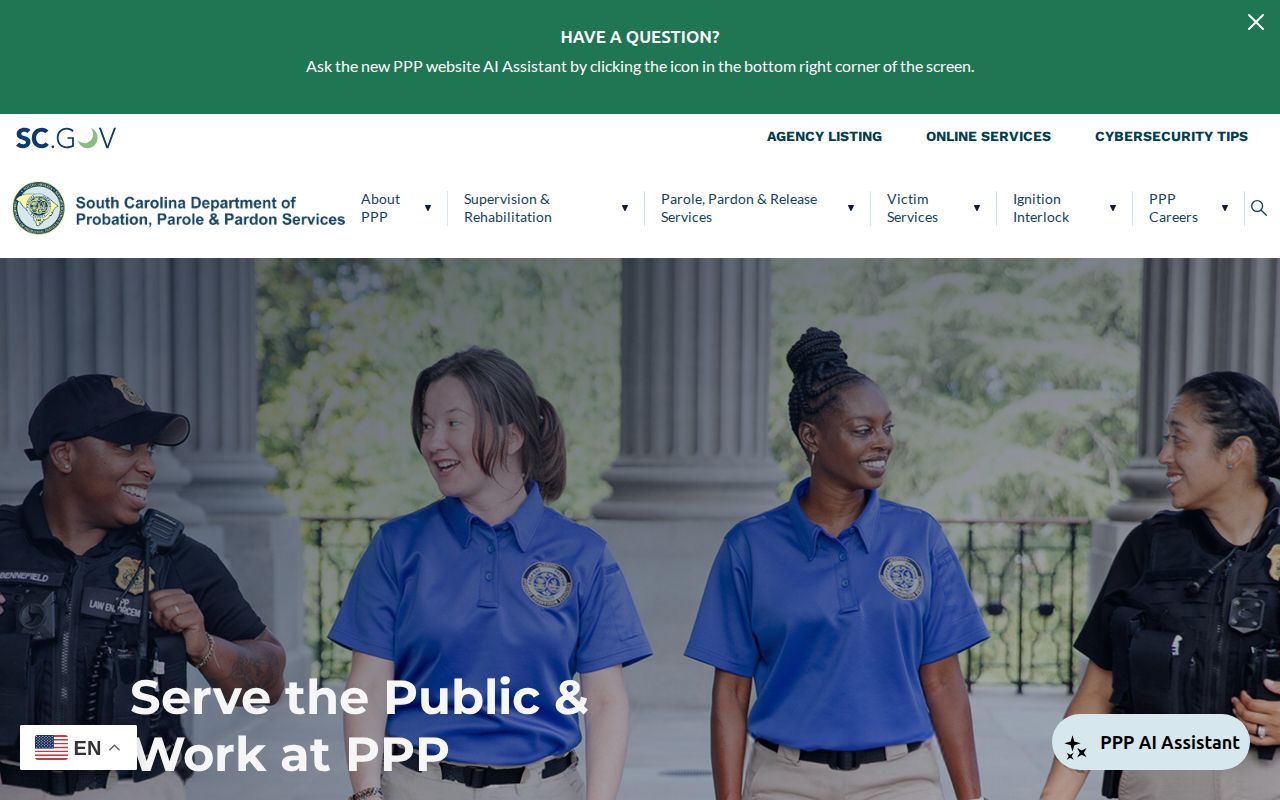
This screen belongs to the supervision agency, not the Kershaw jail roster. That distinction keeps a community-status result separate from proof of physical release.
Important: A positive SCDPPPS match confirms a supervision relationship. It does not by itself identify the jail, prison, or time of departure.
Kershaw Probation and Parole Office
Kershaw County has a dedicated supervision office in Camden. That local channel is important because the public database is a prior-day snapshot and the county directory can identify the responsible jurisdiction. Staff can clarify whether the person is assigned locally, whether the status displayed online is current, and where an authorized records question should go. The directory also publishes date-stamped counts for probation, parole, community supervision, supervised reentry, and other statuses. Those counts describe the office workload, not the number of people released from KCDC.
SCDPPPS Kershaw County Office
703 Lafayette Avenue
Camden, SC 29020
Mail: P.O. Box 896
Camden, SC 29020
Phone: 803-425-1510
Fax: 803-425-7196
The official Kershaw office page is also the source for its current contact details and jurisdictional figures. The screenshot below captures that local directory rather than a generic statewide contact page.
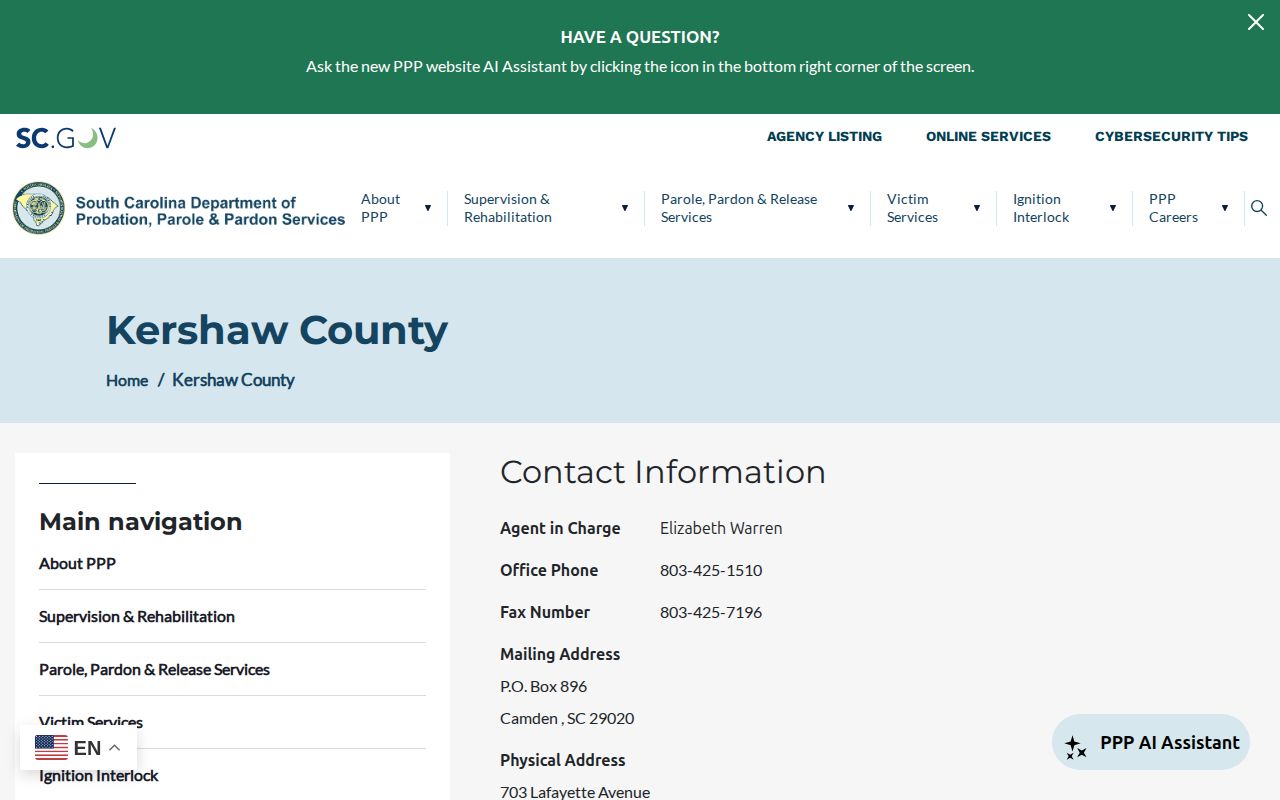
Use the listed office number when same-day verification matters. Personnel and counts can change, so the live directory controls over an older copy.
Note: Ask staff to repeat the exact supervision category, because parole, probation, community supervision, and supervised reentry have different meanings.
Kershaw Parole Hearing Records
A projected parole-eligibility date is only a chance for Board review. It is not an order to release. SCDPPPS supports the seven-member South Carolina Board of Paroles and Pardons and hosts the Parole and Pardon Hearings Search. The accepted searches include first and last name, SCDC number, a name with hearing month, or the month alone. Searchable dates are generally finalized about 30 days before the hearing, and the agency advises users to check again for schedule changes and posted results.
Open the matching hearing and record the exact date and result. A result may show granted, denied, rescheduled, or deferred action, but only the displayed official wording should be repeated. A grant still requires release processing, conditions, and a final custody check. A denial does not itself change present custody. The annual Board calendar helps with planning, while the named-person search supplies the case-level entry. Neither replaces SCDC's custody record or an actual release timestamp.
South Carolina Code Title 24, Chapter 21 governs parole and supervision. Section 24-21-610 includes baseline parole-eligibility rules and offense-specific limits. Board criteria can address the offense, prior record, and conduct in custody, but they do not create a promise of release. The safest method is to compare the SCDC projected eligibility field, the Board hearing record, and the later release or supervision record.
Kershaw Supervision Warrants and Absconders
An absconder label means the supervision agency alleges that a person stopped reporting or became unavailable. A warrant can follow, but neither term proves that the person is now inside the Kershaw County Detention Center. Current custody must be checked with the agency that holds the person. The earlier release also remains a separate event, even if supervision enforcement later returns the person to custody.
SCDPPPS maintains a statewide Most Wanted Offenders page with county filtering. Kershaw County does not publish a separate local absconder list in the reviewed sources. Use the official state page, compare identity details, and contact SCDPPPS about any match. Then check the current Kershaw inmate list or call the holding agency. The live Kershaw list is only a custody snapshot; absence there does not clear a warrant or prove release.
Do not merge records: An enforcement listing, a current jail roster, and a prior supervision record answer three different questions.
Kershaw Supervision Conditions and Violations
Conditions are the rules attached to a person's specific order and status. They can concern reporting, approved movement, programs, payments, or other obligations stated by the court, Board, or supervising agency. The public search is not a full copy of those terms. The controlling sources are the signed order and SCDPPPS record. A violation is an alleged breach of a condition; it is not the same as a new conviction, and its effect depends on formal agency and court action.
If a custody change may follow a violation, verify each stage. SCDPPPS can confirm supervision and enforcement status. The Kershaw County Detention Center can address present county custody. SC VINE may provide an alert for a participating custody event, but it does not issue the warrant or decide the violation. State-prison custody belongs to SCDC, not the county detention center.
These distinctions prevent a common error. A person can remain legally supervised while living in the community. Another person can be detained on an alleged violation without having been discharged from the original supervision term. Read the dated status and ask the responsible office what changed.
Kershaw Parole and Probation Discharge
Supervision ends through a formal discharge or other lawful closing action, not merely because a name stops appearing in a public search. South Carolina's database states that a person no longer supervised may be absent. For that reason, preserve the last known status and ask SCDPPPS for the current record. When probation arose from a Kershaw County sentence, the court file can supply the sentencing terms and later orders. For parole or a state community-supervision status, SCDC and SCDPPPS records explain different parts of the transition.
Section 24-21-560 describes community supervision following the custody portion of qualifying no-parole sentences. Successful completion satisfies that sentence and results in discharge. Until that point, a release from the prison building is not necessarily the end of all legal obligations. The SCDC released list may use labels such as COMMUNITY SUPV or SUPV RE-ENTRY; those terms should remain intact rather than being shortened to unconditional release.
South Carolina FOIA governs access to existing public records, subject to exemptions and lawful redaction. It does not require an agency to create a new supervision history. Juvenile, sealed, and expunged matters may be withheld or removed as other law requires. A missing public result therefore should not be described as proof of discharge, error, or any other legal outcome. Ask for a narrow existing record and respect the limits stated by its custodian.
For a projected state transition, compare the date and supervision fields through the Kershaw County projected release process. For a completed KCDC departure, request the county booking and release record. A clean chain of sources shows custody departure, supervision type, and eventual discharge without forcing one database to answer every question.
Note: A search result can change after the daily update, so retain the date checked and verify urgent facts by phone.